2. The principles in Brief
Transdisciplinary Research (TR)
"There is a need for TR when knowledge about a societally relevant problem field is uncertain, when the concrete nature of problems is disputed, and when there is a great deal at stake for those concerned by problems and involved in dealing with them. (Pohl y Hirsch Hadorn, 2007, p. 20)
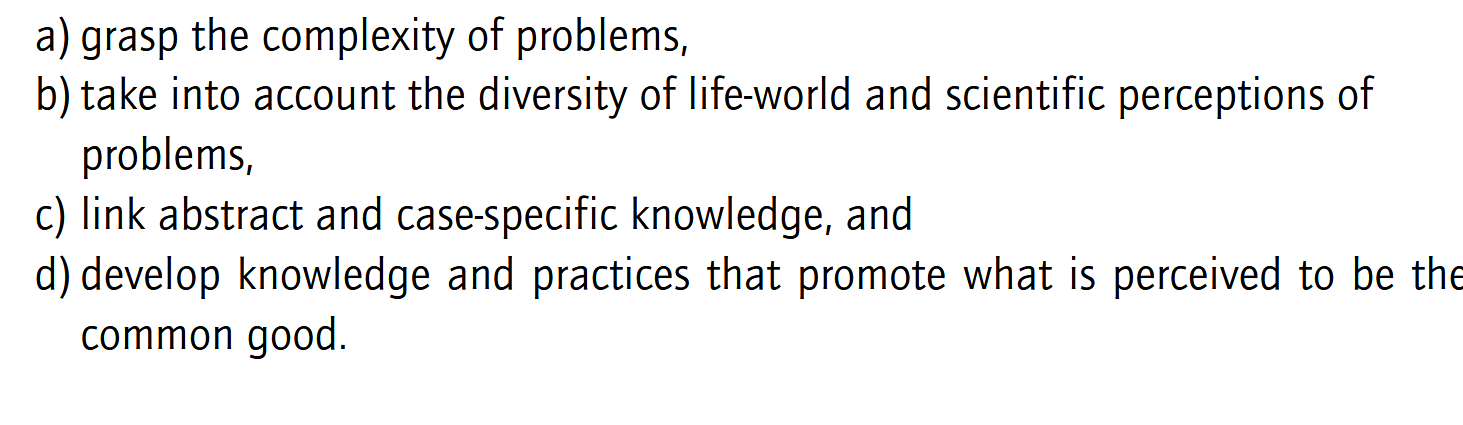
TR deals with problem fields in such a way that it can:
[image]
(pdf)
(Pohl y Hirsch Hadorn, 2007, p. 20)
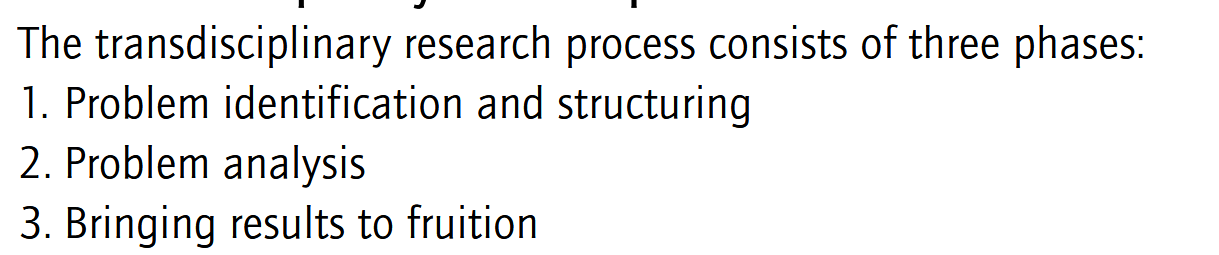
Transdisciplinary research process
[image]
 (pdf)
(pdf)
(Pohl y Hirsch Hadorn, 2007, p. 20)
"TR does not necessarily progress through the phases in the order mentioned above. For example, identifying and structuring problems can lead to the insight that no further research is necessary because enough knowledge is available to develop suggestions for feasible solutions. In other cases, problem analysis and bringing results to fruition may lead to the conclusion that problem identification or structuring needs to be revised and adapted." (Pohl y Hirsch Hadorn, 2007, p. 20) (pdf)
Four requirements of trandisciplinary research at the stage of analysing a problem
"(a) to come to terms with complexity, (b) to take into account diversity, (c) to develop case-specific and practice-oriented knowledge that can be transferred and (d) oriented towards what is perceived to be the common good – is risky, as this might overload the project with prerequisites, as if it were supposed to become the proverbial ”all things to all people”." (Pohl y Hirsch Hadorn, 2007, p. 20) (pdf)
1st principle: Reduce complexity by specifying the need for knowledge and identifying those involved
"When trying to come to terms with the complexity of problems, it is crucial to consider only those relations relevant to practice-oriented problem-solving" (Pohl y Hirsch Hadorn, 2007, p. 20) (pdf)
TR deals with:
- "empirical questions (systems knowledge); it also aims to ascertain and explain better practices (target knowledge) and reflect on the practicability of goals and feasibility of proposed solutions to problems (transformation knowledge)" (Pohl y Hirsch Hadorn, 2007, p. 21) (pdf)
"two means of adequately reducing complexity are to specify the particular need for knowledge and identify the people involved" (Pohl y Hirsch Hadorn, 2007, p. 21) (pdf)
Me parece curioso cómo la transdisciplina toma como referentes términos y conceptos de las ciencias de la computación y la informática.
"Specifying the need for knowledge implies discerning what research questions need to be addressed by a project and determining the corresponding conditions. To this end, it is necessary to find out what kind of systems perception underlies a project, what normative targets it has set itself, and what potential societal transformations it aims at" (Pohl y Hirsch Hadorn, 2007, p. 21) (pdf)
2nd principle: Archivie effectiveness through contextualisation
"TR aims to develop knowledge that helps solve ”life-world” (or everyday-life) problems concretely" (Pohl y Hirsch Hadorn, 2007, p. 21) (pdf)
"Research must therefore pay particular attention to the impact-related contextualisation of a project." (Pohl y Hirsch Hadorn, 2007, p. 21) (pdf)
"One way of achieving this is to elaborate an impact model at the stage of problem identification and structuring that shows the social impacts projects may have when bringing results to fruition." (Pohl y Hirsch Hadorn, 2007, p. 21) (pdf)
"Projects must therefore assess the state of knowledge not only in relation to the research questions identified, but also with regard to concrete societal practices and issues in the life-world" (Pohl y Hirsch Hadorn, 2007, p. 21) (pdf)
"In order to make research results accessible to those concerned, it is essential to reformulate them: Scientific insights must be summarised and assessed for specific target groups; they must be translated creatively into products useful to these groups; and it is necessary to reflect on how these products will fit target groups’ current practices and agendas" (Pohl y Hirsch Hadorn, 2007, p. 21) (pdf)
"This can be achieved by linking current efforts to the state of the art in the relevant disciplines, by learning from transdisciplinary work on similar problems (even in other thematic realms), and by systematising and publishing experiences garnered in a project" (Pohl y Hirsch Hadorn, 2007, p. 22) (pdf)
3rd principle: Archive integration though open encounters
"This implies perceiving one’s own perspective as only one among several others, and accepting other views as potentially just as relevant as one’s own. Only thus can constructive discussions about the potential of the various perspectives to contribute to the common undertaking take place and be further developed" (Pohl y Hirsch Hadorn, 2007, p. 22) (pdf)
"Collaboration can take various forms (common learning as a group, negotiations among experts, integration through the project leader), and be based on different modes of integration (”boundary objects”, glossary, everyday language, models, transfer of concepts, mutual adaptation of concepts, developing bridge concepts)" (Pohl y Hirsch Hadorn, 2007, p. 22) (pdf)
"Depending on the form of collaboration and mode of integration, the intensity of reflection about one’s own and other actors’ perspectives can vary" (Pohl y Hirsch Hadorn, 2007, p. 22) (pdf)
"This is why it is important to determine the mode and concrete process of integration in a common and open procedure, in order to ensure that it is adapted to problem structuring and questions that have been defined above" (Pohl y Hirsch Hadorn, 2007, p. 22) (pdf)
4th principle: Develop reflexivity through recursiveness
"Fulfilment of the requirement that TR must, in the phase of problem analysis, (a) encompass the complexity of a problem field, (b) take into account diversity, (c) develop knowledge that is both relevant to specific cases as well as transferable, and (d) develop practice-oriented solutions for what is perceived to be the common good, often seems to be possible only to a limited degree." (Pohl y Hirsch Hadorn, 2007, p. 22) (pdf)
"One means of preventing this is to shape the research process recursively (or iteratively). Recursiveness (or iteration) implies foreseeing that project steps may be repeated several times in case of need" (Pohl y Hirsch Hadorn, 2007, p. 22) (pdf)
"The possible limitation or uncertainty of a preliminary result thus becomes a means of targeted learning. Recursiveness is important in all three phases of the research process. With regard to bringing results to fruition, this implies introducing recursiveness not just at the end but already in the course of the research process, so that recursive adaptations are possible" (Pohl y Hirsch Hadorn, 2007, p. 23) (pdf)
"Reflexivity thus means to correct assumptions on which the production of knowledge is based, in case the real-world experiment reveals that these assumptions need to be corrected" (Pohl y Hirsch Hadorn, 2007, p. 23) (pdf)