3. Transdisciplinary Research
Four characteristics of transdisciplinary research:
[image]
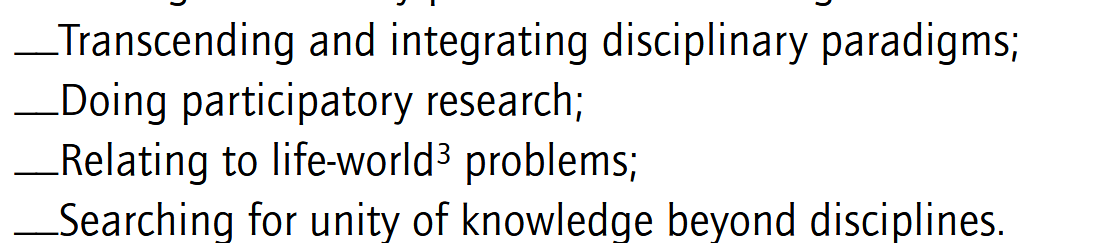
(pdf)
(Pohl y Hirsch Hadorn, 2007, p. 26)
3.1 Starting point, goal and requirements
"The starting point for TR is a socially relevant problem field.1" (Pohl y Hirsch Hadorn, 2007, p. 26) (pdf)
"A problem field (e.g. violence, hunger, poverty, disease, environmental pollution) refers to a life-world area in which empirical and practice-oriented issues call for knowledge" (Pohl y Hirsch Hadorn, 2007, p. 26) (pdf)
"This does not mean that there is always general agreement about the need for action, nor about the type of strategy required." (Pohl y Hirsch Hadorn, 2007, p. 26) (pdf)
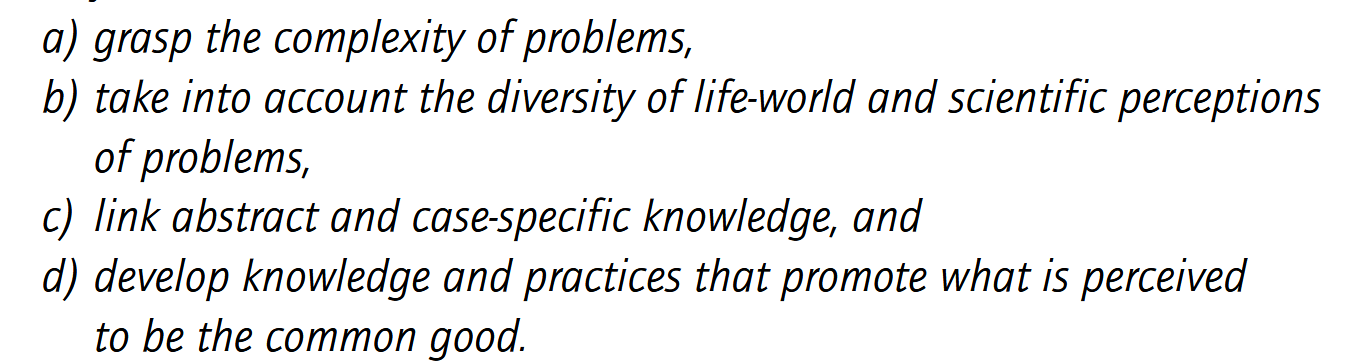
"The aim of TR is to develop empirical and practice oriented knowledge that can help solve, mitigate or prevent life-world problems. When pursuing this goal and identifying, structuring, analyzing and dealing with concrete problems in a problem field, it is necessary to consider four fundamental requirements." (Pohl y Hirsch Hadorn, 2007, p. 26) (pdf)
-
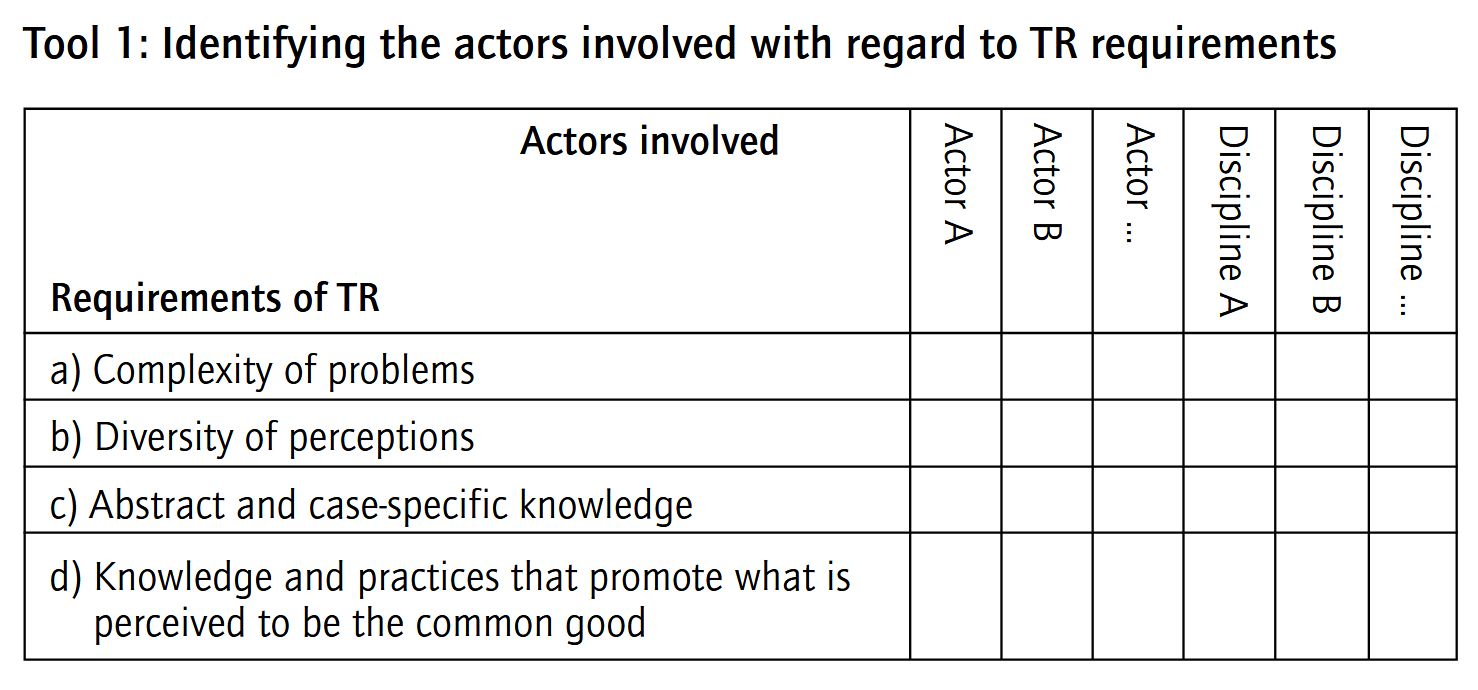
TR takes into account the complexity of problems:
- "TR must include relevant relations between the social and natural factors that constitute a problem and might influence possible solutions. To this purpose, it is necessary to grasp the dynamic interdependencies of empirical insights, technical options, value orientations and policy options." (Pohl y Hirsch Hadorn, 2007, p. 27) (pdf)
-
TR takes into consideration the diversity of scientific and life-world perspectives on problems" (Pohl y Hirsch Hadorn, 2007, p. 27)
- "Actors in science and the life-world do not have the same perception of what factors induce a problem; nor are these two groups homogenous" (Pohl y Hirsch Hadorn, 2007, p. 27) (pdf)
- "This diversity and complexity must be taken into account when identifying and structuring problems, by establishing relations between the perspectives with a focus on how to deal with the given problems in the life-world. Often, the various perspectives that are considered in this manner are not complementary: They may actually contradict one another, in which case they require reciprocal correction" (Pohl y Hirsch Hadorn, 2007, p. 27) (pdf)
-
TR links abstract and case-specific knowledge:
- "In order to help find solutions that can become effective within a specific problem field, TR must build a bridge between scientific knowledge produced under idealized conditions and processes in a concrete situation.11 It must establish relations between different forms of relevant, case-specific and transmissible knowledge." (Pohl y Hirsch Hadorn, 2007, p. 27) (pdf)
-
TR develops knowledge and practices that promote what is perceived to be the common good:
#biencomún- "By dealing explicitly with the question of whether proposed solutions serve the common good, TR enables those involved to achieve a consensus about solutions – an important condition given the fact that actor groups in the private sector, public agencies, and civil society can hold controversial positions" (Pohl y Hirsch Hadorn, 2007, p. 27) (pdf)
"The transdisciplinary research process should clarify how to understand the concept of the common good and its implications as a normative principle for dealing with problems in the life-world." (Pohl y Hirsch Hadorn, 2007, p. 29) (pdf)
Tool 1: Identifiyng the actors involved with regard to TR requirements
[image]
(pdf)
(Pohl y Hirsch Hadorn, 2007, p. 30)
"The starting point for TR is a socially relevant problem field. Within this field, TR identifies, structures, analyses and deals with specific problems in such a way that it can:" (Pohl y Hirsch Hadorn, 2007, p. 30) (pdf)
[image]
 (pdf)
(pdf)
(Pohl y Hirsch Hadorn, 2007, p. 30)
3.2 Identifying and structuring research questions
"Research is expected to improve the general models of a discipline by which processes are described, analysed and explained" (Pohl y Hirsch Hadorn, 2007, p. 32) (pdf)
"The progress of knowledge in basic research can open new ways of dealing with problems in the life-world, but it is applied research and TR that develop the means required by actors for improving practices in the life-world." (Pohl y Hirsch Hadorn, 2007, p. 33) (pdf)
"TR is different from basic research and applied research in that it does not initially seek to reduce the diversity and complexity of problem fields from the perspective of a certain discipline or of a certain actor in the life-world" (Pohl y Hirsch Hadorn, 2007, p. 35) (pdf)
About resarch instruments:
- " #Basicresearch , applied research and TR are three different forms of research (ideal types) that complement and enhance one another. They do not compete for the overall title of ”best research form" (Pohl y Hirsch Hadorn, 2007, p. 35) (pdf)
- "Basic research is not directly in touch with actors in the life-world. This does not mean, however, that such research is fundamentally independent of values and practices in the life-world. Basic research is an important prerequisite for applied and transdisciplinary research and thus indirectly connected with what is perceived to be important in the life-world. But if values and practices in the life-world are uncontested they are often not debated, which, however, does not mean that basic research and life-world orientations do not influence one another." (Pohl y Hirsch Hadorn, 2007, p. 35) (pdf)
- " #Appliedresearch often directly refers to life-world actors’ practice-oriented issues. However, this does not necessarily imply that it serves only individual interests." (Pohl y Hirsch Hadorn, 2007, p. 36) (pdf)
- "TR develops knowledge and practices that promote what is perceived to be the common good." (Pohl y Hirsch Hadorn, 2007, p. 36) (pdf)
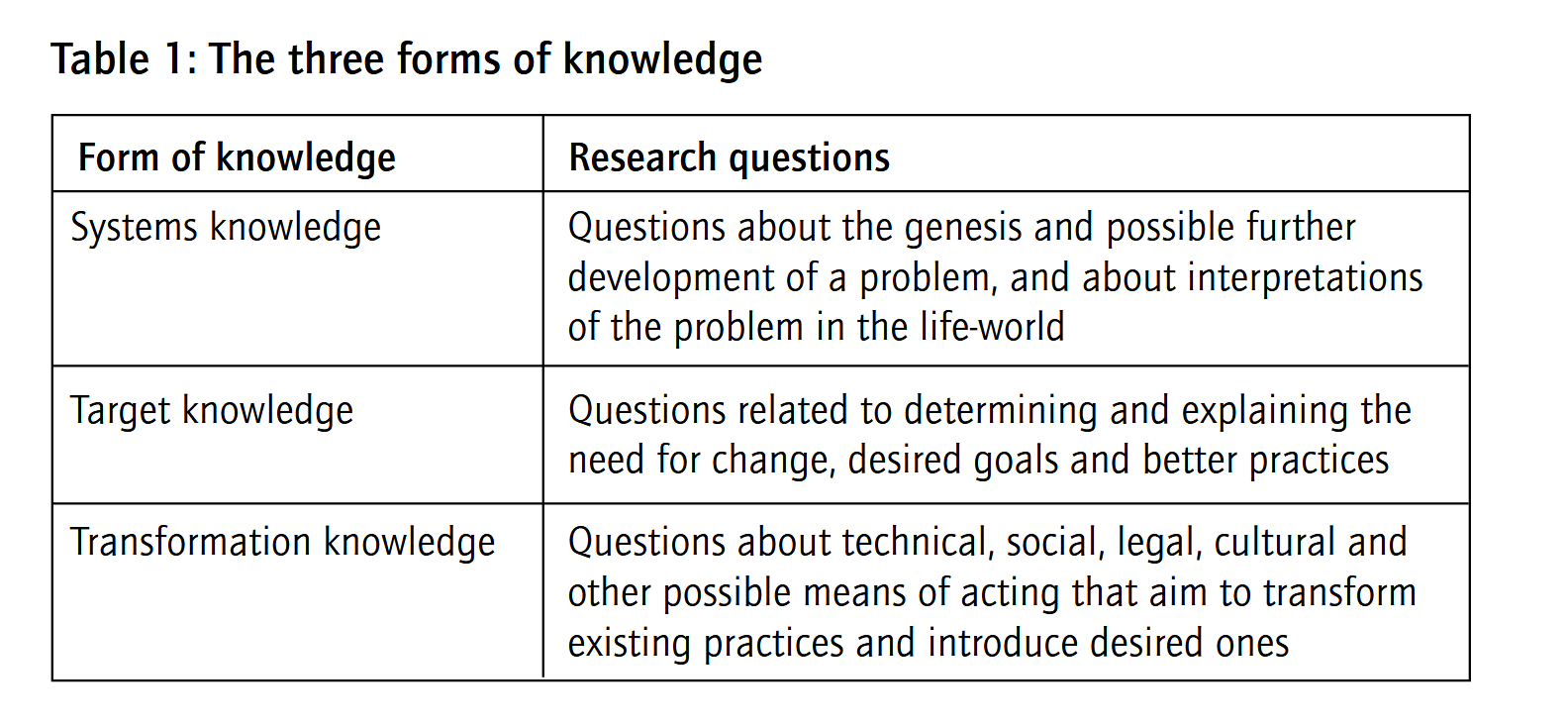
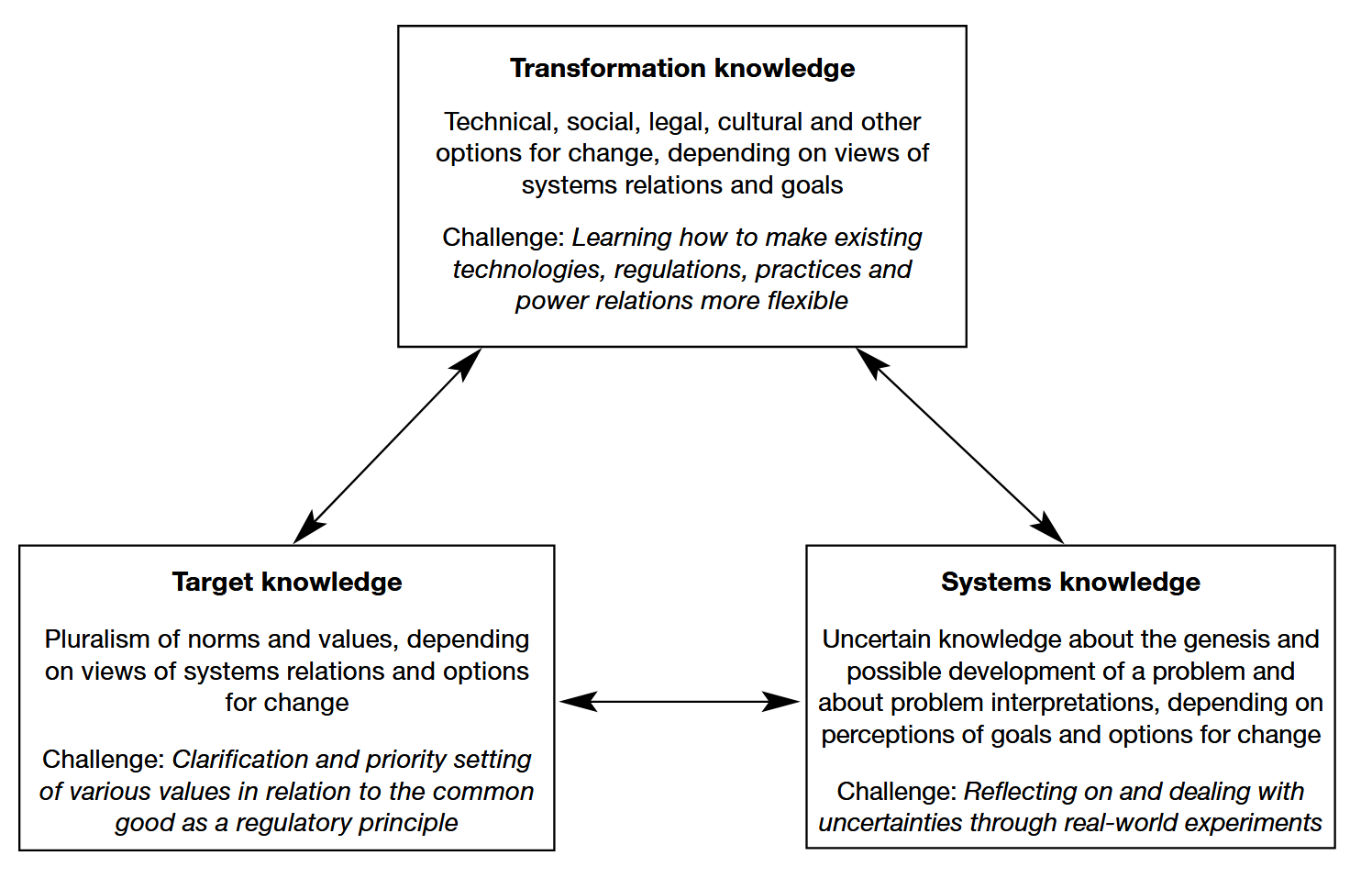
3.2 Systems, target and transformation knowledge
"TR addresses three kinds of research questions:" (Pohl y Hirsch Hadorn, 2007, p. 36) (pdf)
-
"(a) questions about the genesis and possible development of a problem field, and about interpretations of the problems in the life-world;" (Pohl y Hirsch Hadorn, 2007, p. 36) (pdf)
-
"(b) questions related to determining and explaining practice-oriented goals;" (Pohl y Hirsch Hadorn, 2007, p. 36) (pdf)
-
"(c) questions that concern the development of pragmatic means (technologies, institutions, laws, norms etc.) as well as the possibility of transforming existing conditions" (Pohl y Hirsch Hadorn, 2007, p. 36) (pdf)
[image]
 (pdf)
(pdf)
(Pohl y Hirsch Hadorn, 2007, p. 36)
-
-
"confronts the difficulty of how to deal with uncertainties." (Pohl y Hirsch Hadorn, 2007, p. 37) (pdf)
-
"Furthermore, empirical or theoretical knowledge about a problem may be lacking, and depending on the interpretation of a problem, these uncertainties may be assigned different degrees of importance, which leads to diverging assessments of the need for action and of target knowledge and transformation knowledge." (Pohl y Hirsch Hadorn, 2007, p. 37) (pdf)
-
"Therefore, TR faces the challenge of finding a transparent way of dealing with uncertainties in order to avoid blocking the research process." (Pohl y Hirsch Hadorn, 2007, p. 37) (pdf)
-
-
- "the question is what the multiplicity of social goals means for research, for society’s practice-related problems, and for transdisciplinary collaboration between science and actors in the life-world" (Pohl y Hirsch Hadorn, 2007, p. 37) (pdf)
- "TR faces the challenge of clarifying a variety of positions and prioritising them in the research process according to their significance for developing knowledge and practices that promote what is perceived to be the common good." (Pohl y Hirsch Hadorn, 2007, p. 37) (pdf)
-
- "established technologies, regulations, practices and power relations must be taken into account" (Pohl y Hirsch Hadorn, 2007, p. 37) (pdf)
- "When these social, cultural and technological givens are not considered, this leads to the often criticised discrepancy between knowledge and practice.31 For TR, the challenge here is to learn how to make what is established more ”flexible”." (Pohl y Hirsch Hadorn, 2007, p. 37) (pdf)
[image]
 (pdf)
(pdf)
(Pohl y Hirsch Hadorn, 2007, p. 38)
"The resulting interdependencies between the three forms of knowledge are the main viewpoint from which the need for knowledge must be identified and structured" (Pohl y Hirsch Hadorn, 2007, p. 38) (pdf)
"Research questions relating to systems, target and transformation knowledge are not isolated in TR; instead, they can only be answered by referring to the other two forms of knowledge" (Pohl y Hirsch Hadorn, 2007, p. 38) (pdf)
"an empirical analysis of systems relations will refer to a particular means of transforming a specific social practice and to a specific idea of a better practice." (Pohl y Hirsch Hadorn, 2007, p. 38) (pdf)
"When research questions refer to target knowledge, they are examined based on specific assumptions about systems relations and with a view to particular options for transforming existing practice" (Pohl y Hirsch Hadorn, 2007, p. 38) (pdf)
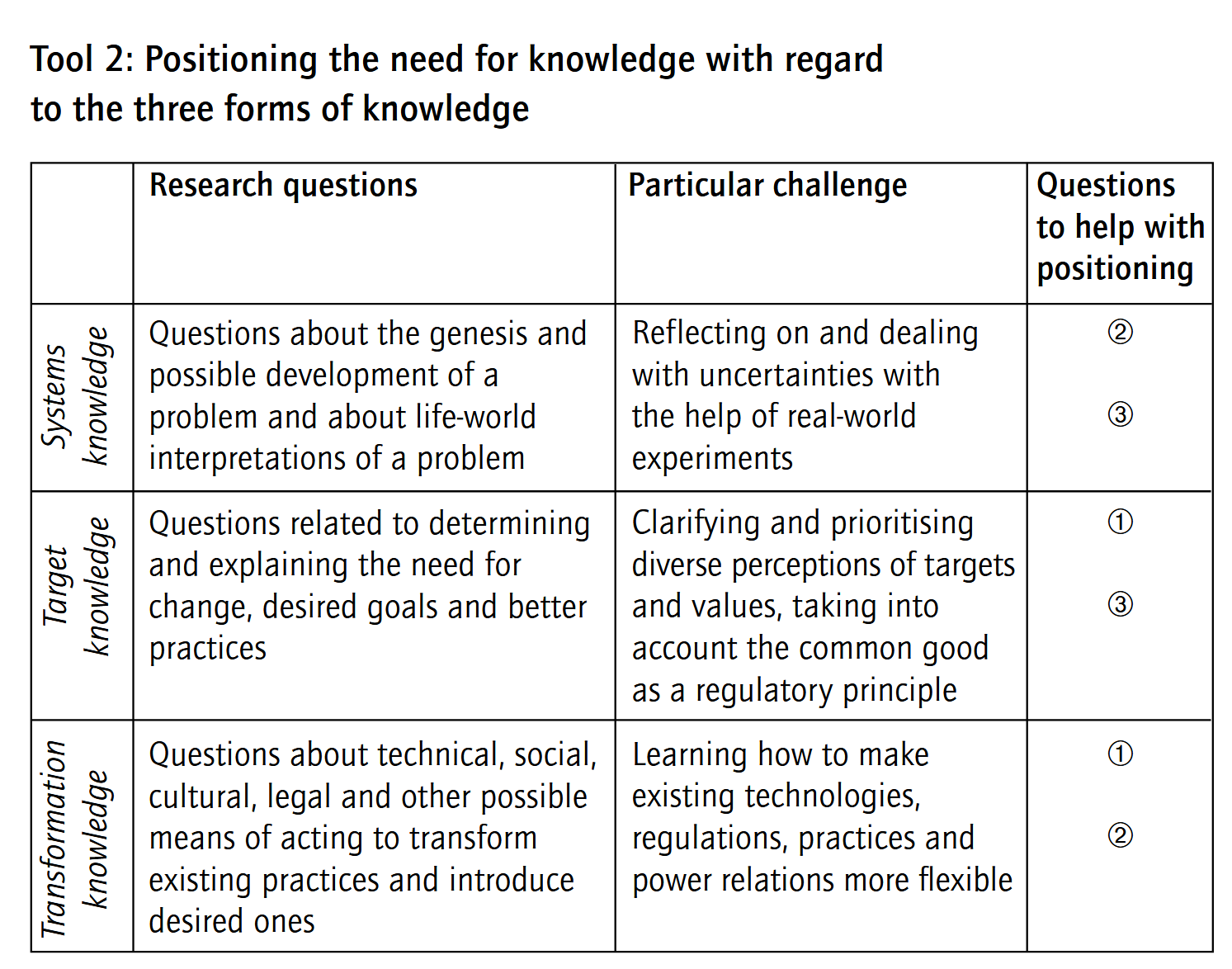
Tool 2. Positioning the need for knowledge with regard to the three forms of knowledge
[image]
 (pdf)
(pdf)
(Pohl y Hirsch Hadorn, 2007, p. 40)
- "To what understanding of the genesis and possible development of a problem and life-world interpretations of it does the research question refer?" (Pohl y Hirsch Hadorn, 2007, p. 40) (pdf)
2)"To what kind of need for change, desired goals and better practices does the research question refer?" (Pohl y Hirsch Hadorn, 2007, p. 40) (pdf)
3)"To what technical, social, cultural, legal and other possible means of acting does the research question refer?" (Pohl y Hirsch Hadorn, 2007, p. 40) (pdf)