4. The transdisciplinary research process
4. The transdisciplinary research process
"three phases" (Pohl y Hirsch Hadorn, 2007, p. 42) (pdf)
[image]
 (pdf)
(pdf)
(Pohl y Hirsch Hadorn, 2007, p. 42)
"It is not necessary to go through the three phases in this order." (Pohl y Hirsch Hadorn, 2007, p. 42) (pdf)
[image]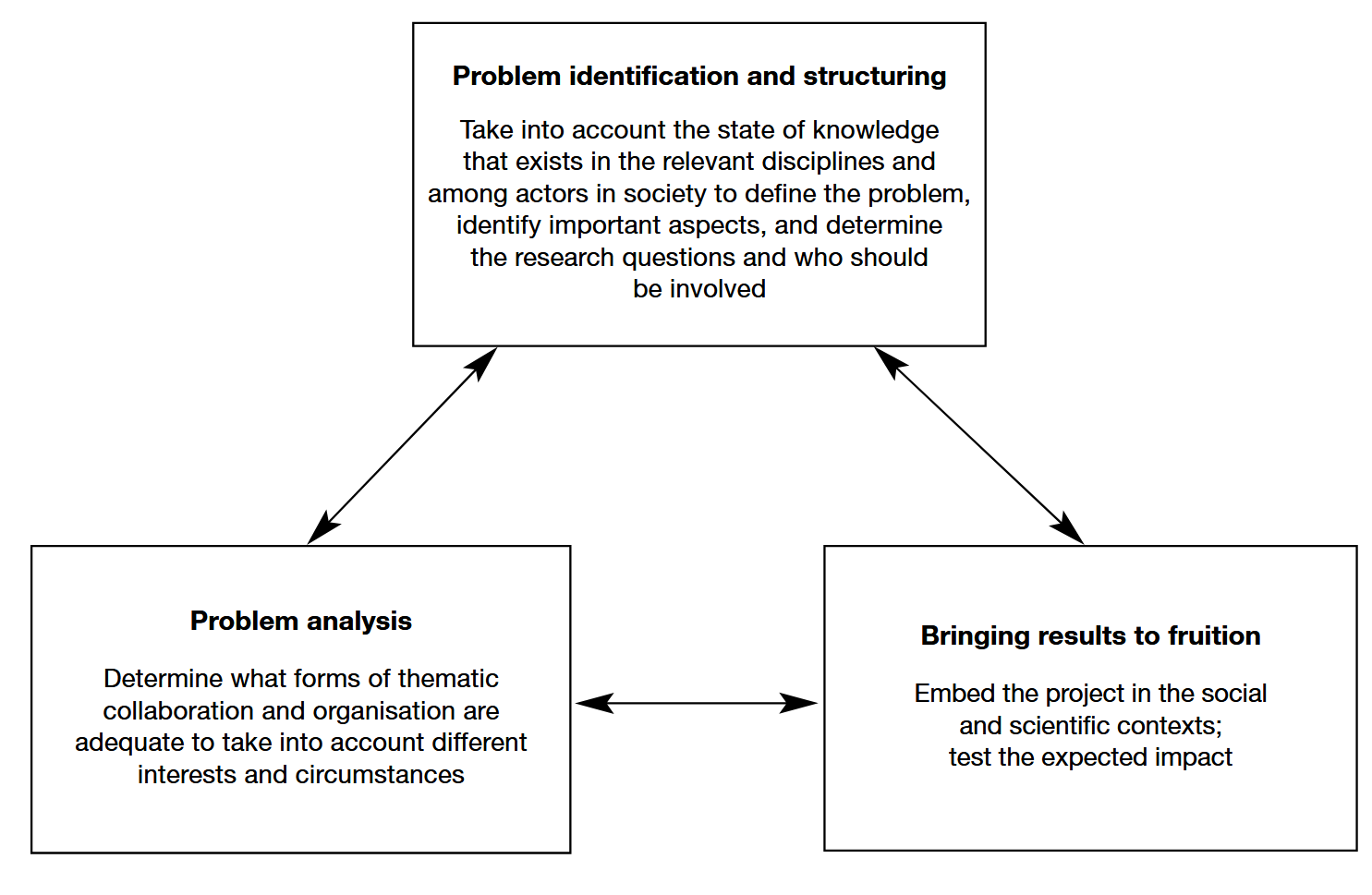 (pdf)
(pdf)
(Pohl y Hirsch Hadorn, 2007, p. 42)
4.1 Recursiveness
"Recursiveness is a general principle of TR. It points to the iterative procedures that characterise both the entire research process and its individual phases. This implies that the research process has to be shaped in such a way that concepts and methods can be repeatedly tested, and that underlying assumptions can be modified if they are found to be inadequate." (Pohl y Hirsch Hadorn, 2007, p. 43) (pdf)
Within the individual phases, a recursive design is a meaningful pragmatic way of working with intermediary results and further developing them with the help of critical assessment. Recursiveness between the phases implies that initial problem identification and structuring can be corrected based on the outcome of problem analysis or bringing results to fruition. A recursive design of the research process thus also serves the purpose of adequately reducing the complexity of problem identification and structuring" (Pohl y Hirsch Hadorn, 2007, p. 43) (pdf)
4.2 Problem identification
4.2.1 Identifiying actors and specifying the need for knowledge
[image] 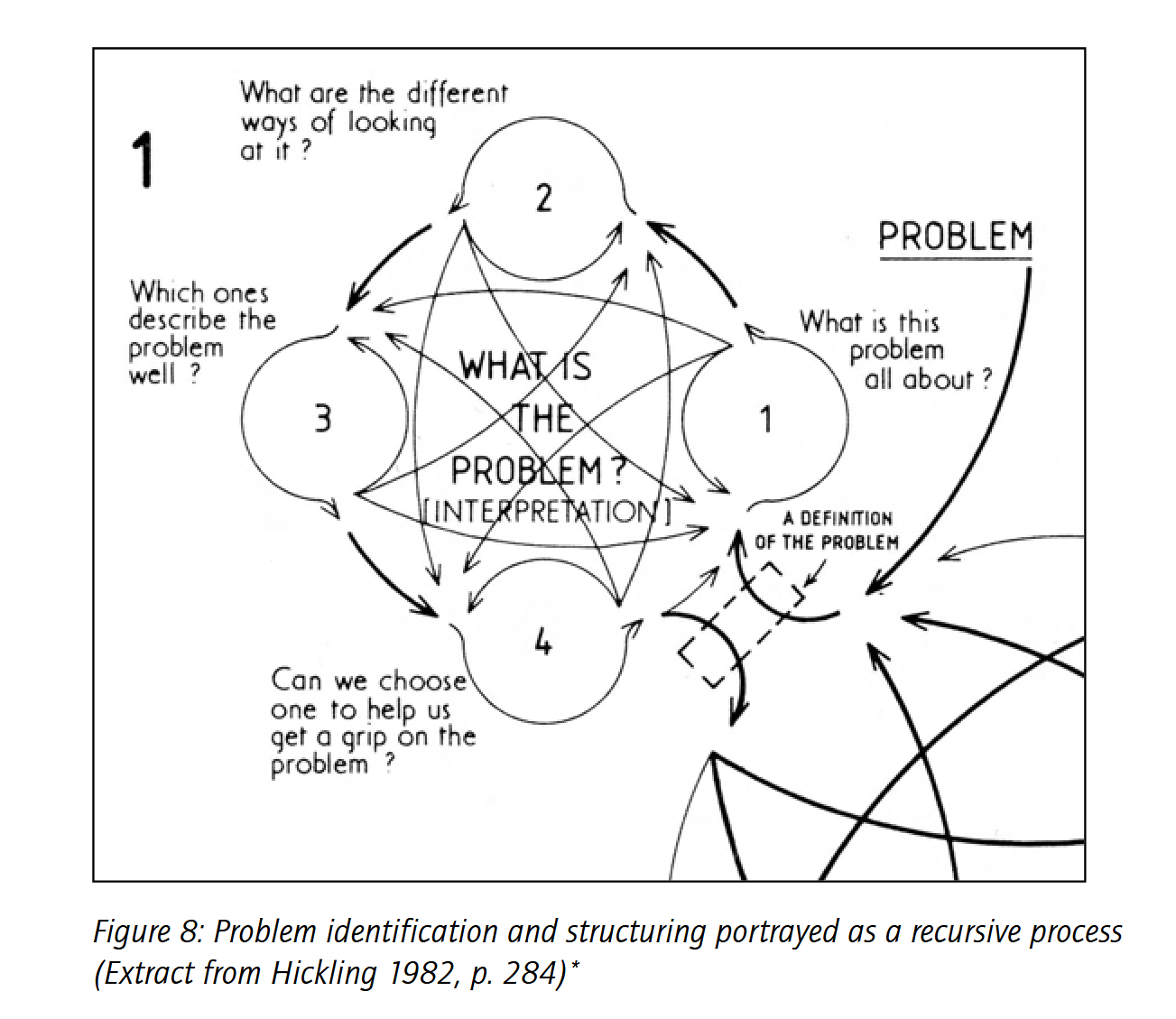 (pdf)
(pdf)
(Pohl y Hirsch Hadorn, 2007, p. 44)
"TR must build on existing disciplinary and life-world perspectives of the problem, and then structure the problem in a manner that enables exploration of the complexity relevant to practice-oriented solutions for what is perceived to be the common good." (Pohl y Hirsch Hadorn, 2007, p. 44) (pdf)
4.2.2 Contextualisation: embedding TR in science and the life-world context
"TR aims to link abstract knowledge to results that are relevant to specific cases, in order to contribute to practice-oriented problemsolving" (Pohl y Hirsch Hadorn, 2007, p. 45) (pdf)
"it is necessary to check carefully whether the manner in which problem identification and structuring, problem analysis, and bringing results to fruition is conducted in other projects can really be carried over to the present project, and what lessons can be learned from the experience of other projects." (Pohl y Hirsch Hadorn, 2007, p. 46) (pdf)
4.2.3 Reformulation of the questions in relation to life-wolrd actors
"TR aims to help solve socially relevant problems in a manner that will serve the common good. It tries to build a bridge between science and the life-world." (Pohl y Hirsch Hadorn, 2007, p. 47) (pdf)
"During the phase of problem identification and structuring, this means that problems previously identified from a scientific perspective need to be related to the actors involved and to specific circumstances, possibly leading to reformulation of the problem or adding of elements" (Pohl y Hirsch Hadorn, 2007, p. 47) (pdf)
4.3 Problem analysis
4.3.1 The structure of problem analysis
[image] 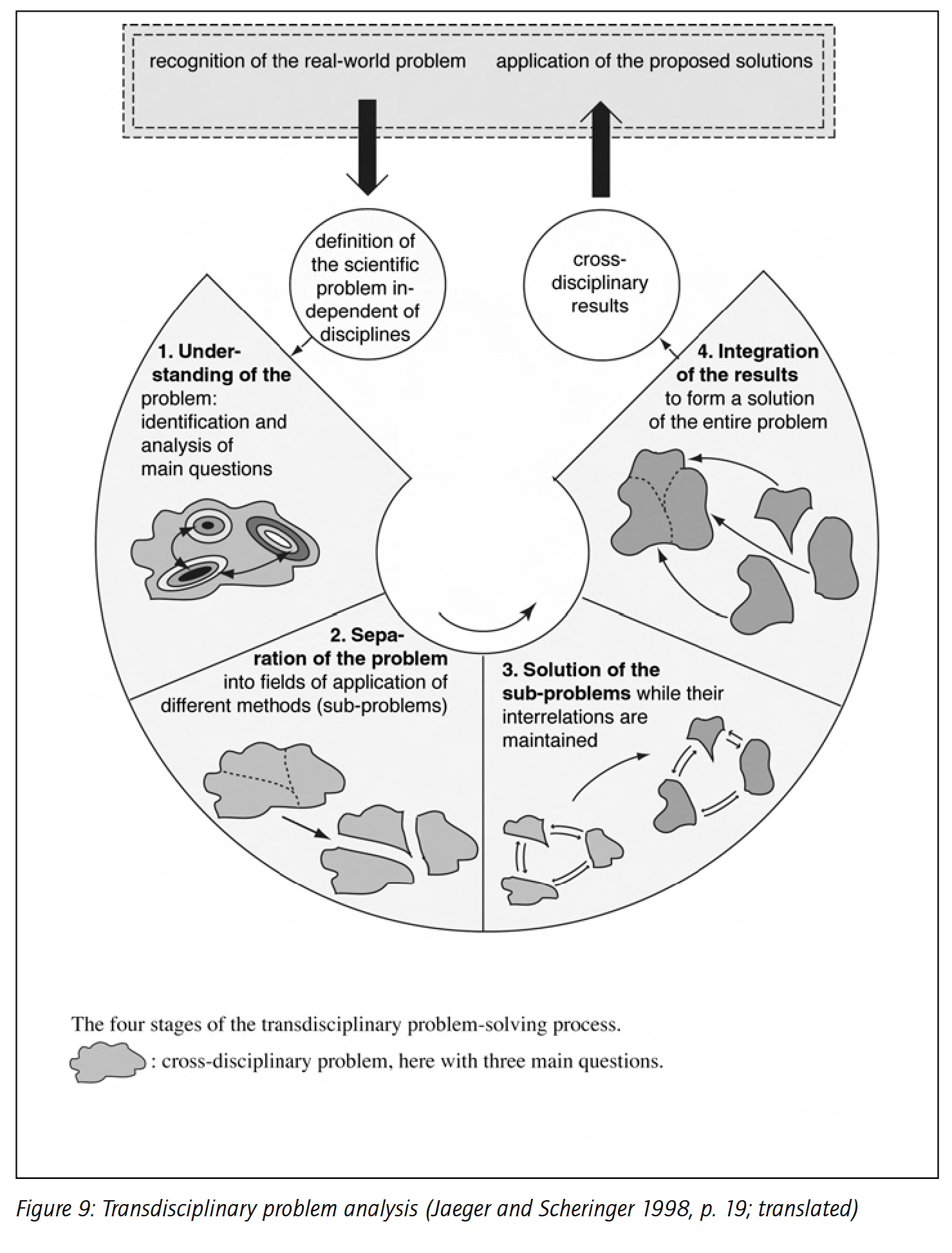 (pdf)
(pdf)
(Pohl y Hirsch Hadorn, 2007, p. 52)
"According to Figure 9, problem analysis consists of three steps:" (Pohl y Hirsch Hadorn, 2007, p. 51) (pdf)
[image]
 (pdf)
(pdf)
(Pohl y Hirsch Hadorn, 2007, p. 51)
4.3.2 Forms of collaboration
[image]
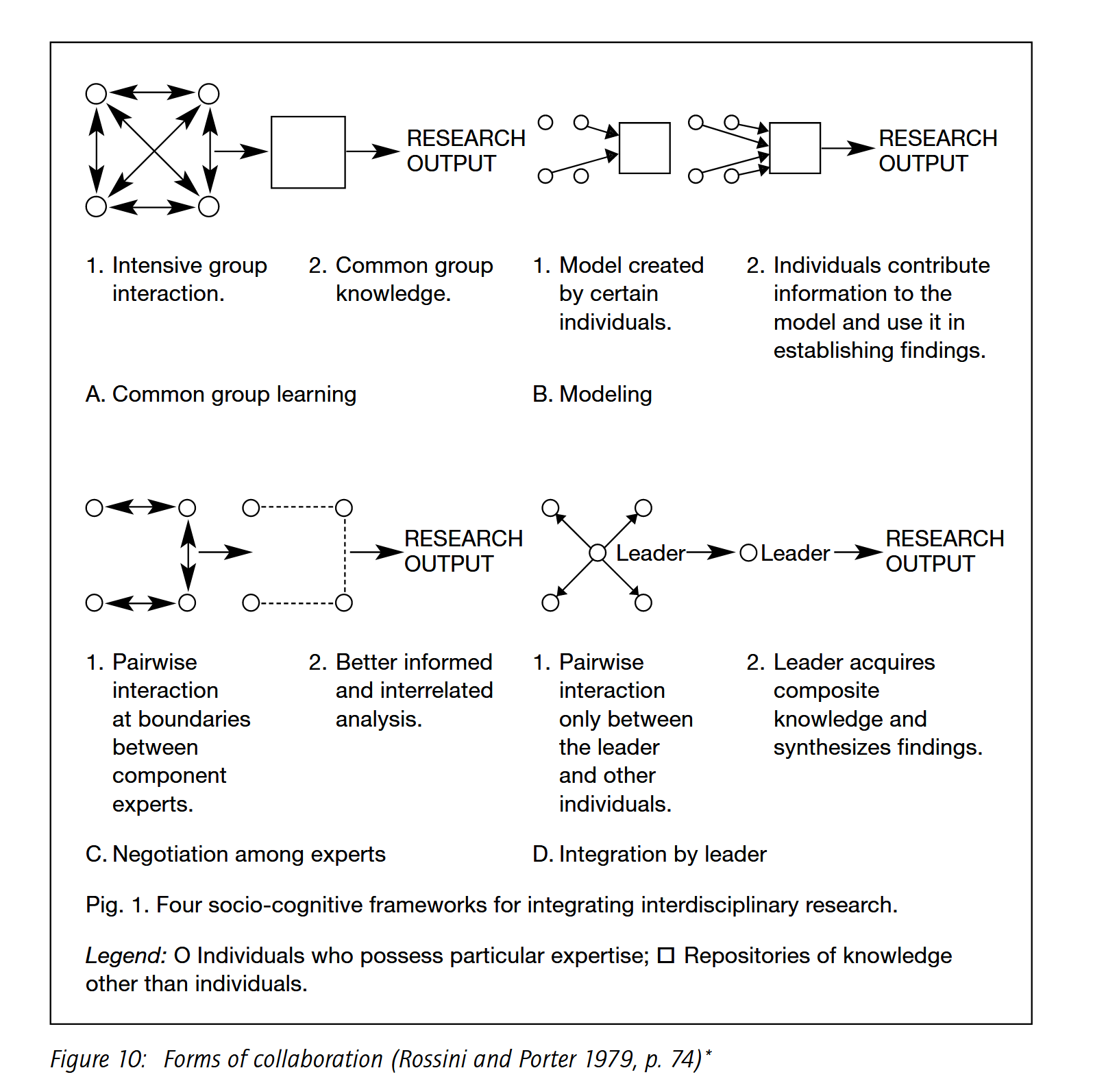 (pdf)
(pdf)
(Pohl y Hirsch Hadorn, 2007, p. 53)
4.3.3 Modes of integration
"To ensure that best use is made of the potential harboured by differentiated perceptions, the most important principle for collaboration in TR is certainly that of open encounters." (Pohl y Hirsch Hadorn, 2007, p. 57) (pdf)
"TR tends to deal with this pluralism in a rather pragmatic way,69 as the motivating and centripetal force of collaboration is mainly founded on the claim that it will develop knowledge and practices that promote what is perceived to be the common good." (Pohl y Hirsch Hadorn, 2007, p. 58) (pdf)
Modes of integration:
- "boundary object, i.e. an object to which all those involved refer based on their specific interest (in shaping things), and which does not require explicit communication between the perspectives" (Pohl y Hirsch Hadorn, 2007, p. 58) (pdf)
- "A glossary leads to integration through clarification of the different concepts and definition of what common concepts should be used, at least for the project." (Pohl y Hirsch Hadorn, 2007, p. 58) (pdf)
- "everyday language, which ”belongs to everyone” (yet is not understood in the same way by everyone). Everyday language is used for example in the ”Popular Theatre” approach" (Pohl y Hirsch Hadorn, 2007, p. 58) (pdf)
- "Models, in the sense of formal structuring, constitute another mode of integration" (Pohl y Hirsch Hadorn, 2007, p. 58) (pdf)
- “mutual adaptation of concepts. This happens when researchers from different disciplines share their specific methods and key concepts in relation to common research questions, and then adapt and further develop them" (Pohl y Hirsch Hadorn, 2007, p. 58)
- "metaphorical transfer of concepts from one discipline to another. This enables the emergence of new ways of looking at and differentiating between things, and new possibilities for action. The original meaning of the concepts is often modified in the process. Metaphorical transfer is illustrated by the attribution of ”momentum” to large technical systems,74 or by the use of the concept of ”syndromes” to describe environmental problems" (Pohl y Hirsch Hadorn, 2007, p. 59) (pdf)
- "bridge concepts. This is a deliberate search for concepts that establish a link between different perspectives by introducing a concept that is useful for collaboration and new to all those involved" (Pohl y Hirsch Hadorn, 2007, p. 59) (pdf)
[image]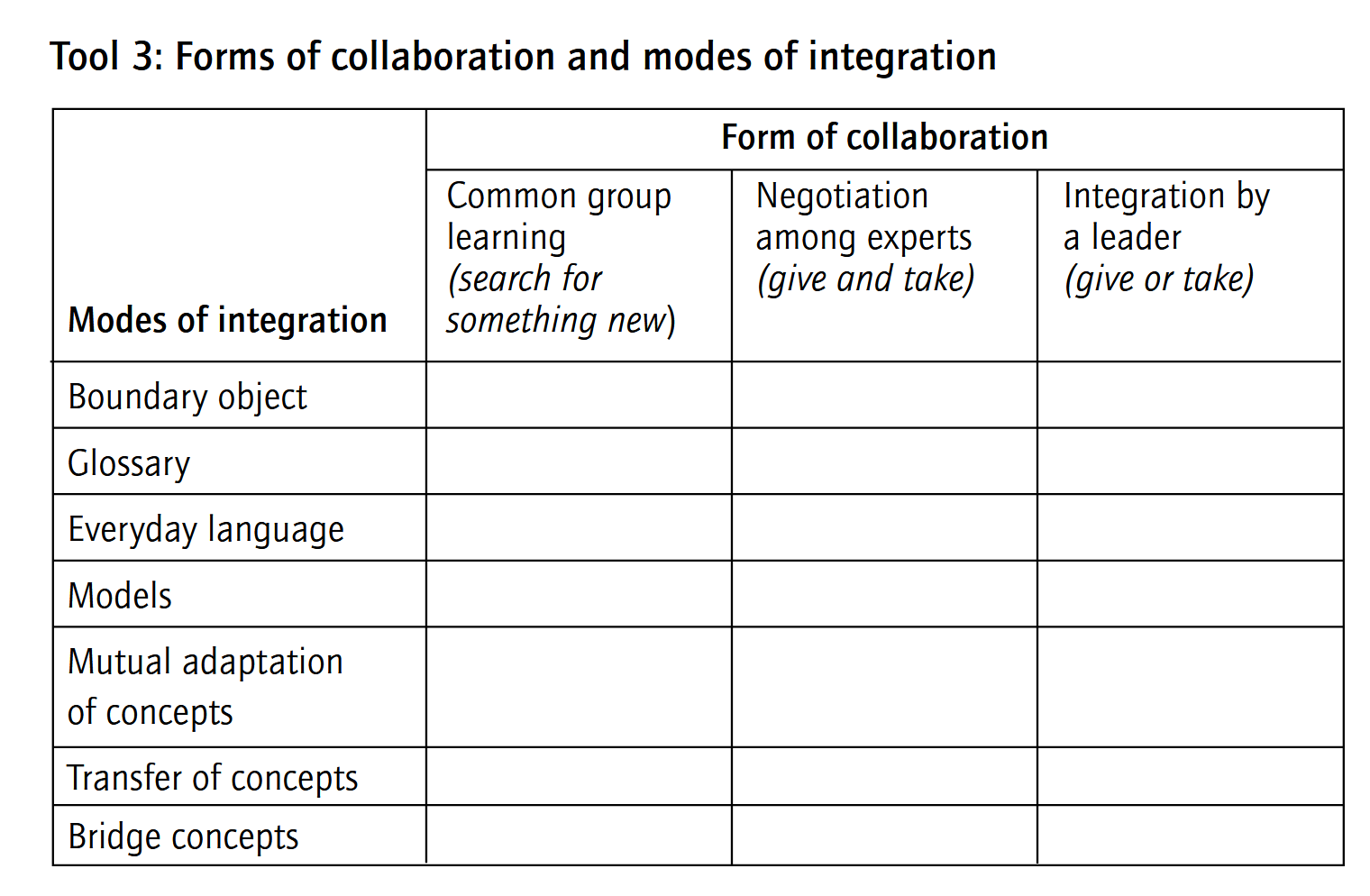
(pdf)
(Pohl y Hirsch Hadorn, 2007, p. 59)
- Various forms of collaboration and modes ofintegration can be used to this purpose
- "As a principle of utmost importance, those involved must encounter one another openly before choosing the form of collaboration and modes of integration. Moreover, the principle of recursiveness requires that decisions already taken can be reconsidered." (Pohl y Hirsch Hadorn, 2007, p. 60) (pdf)
"The form of collaboration and the mode of integration determine the structure and intensity of exchange between those involved. Intense exchange requires a deeper knowledge of one another’s positions and a flexible attitude with regard to one’s own position" (Pohl y Hirsch Hadorn, 2007, p. 60) (pdf)
4.4 Bringing results to fruition
"Various terms are used to refer to the third phase of the research process, e.g. ”implementation”, ”use”, ”dissemination of results”, ”valorisation”, or ”bringing results to fruition”" (Pohl y Hirsch Hadorn, 2007, p. 60) (pdf)
[image]
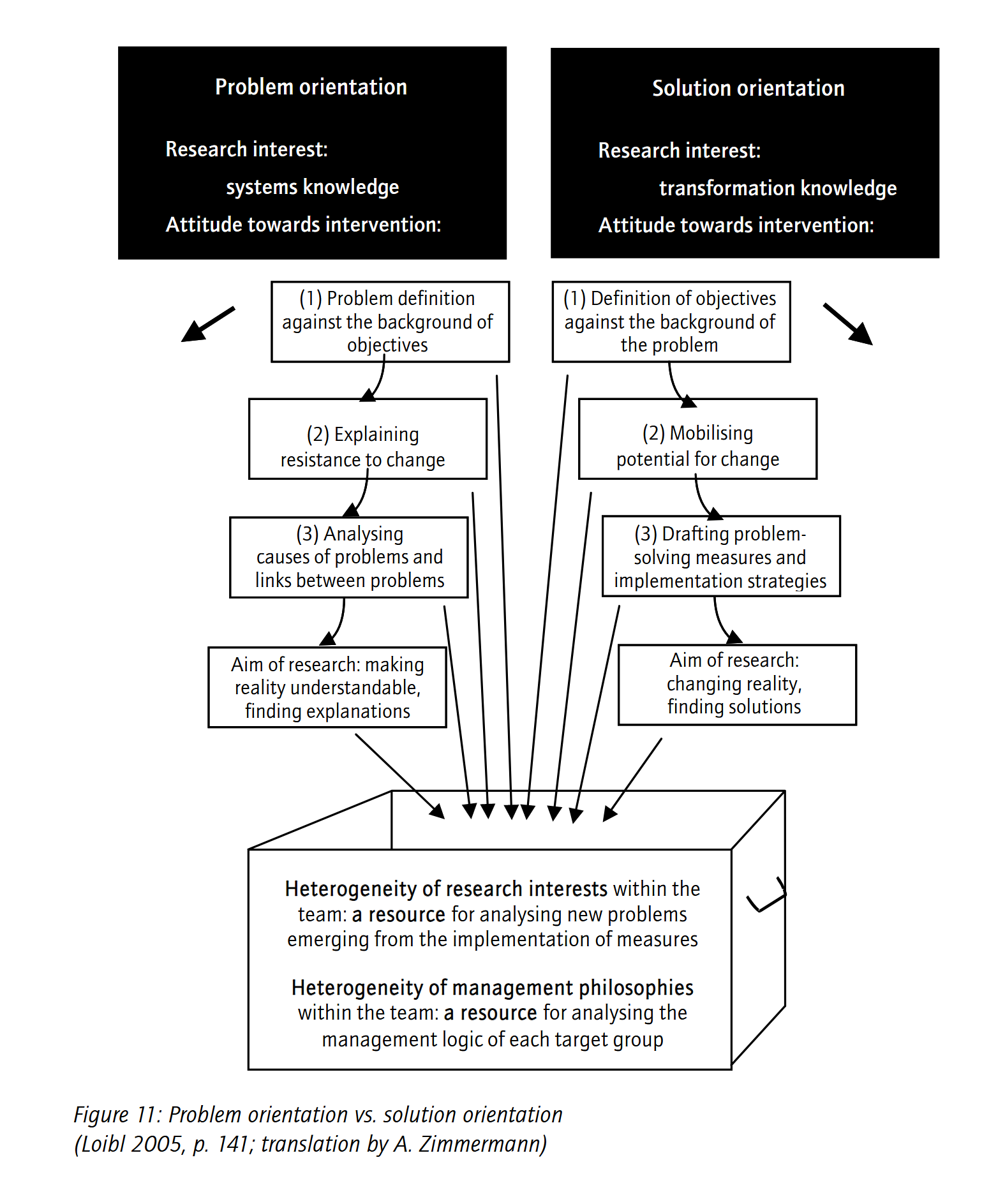 (pdf)
(pdf)
(Pohl y Hirsch Hadorn, 2007, p. 61)
4.4.1 Recursiveness in the phase of bringing results to frution
"A recursive design of this phase makes every instance of bringing results to fruition an experiment that needs to be observed in order to learn something for the next instance of bringing results to fruition." (Pohl y Hirsch Hadorn, 2007, p. 62) (pdf)
[image]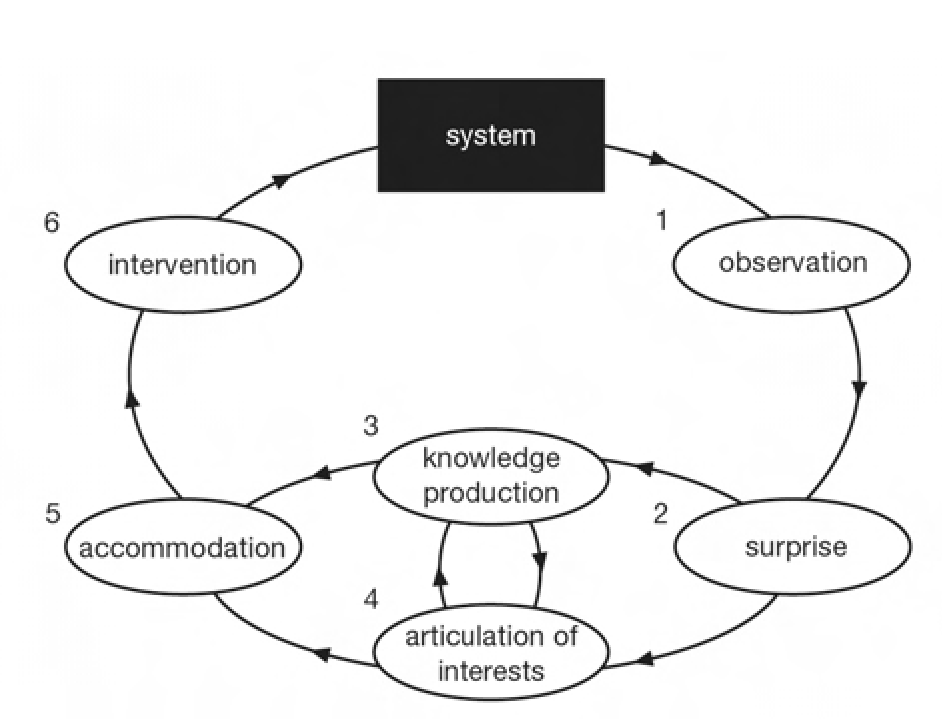 (pdf)
(pdf)
(Pohl y Hirsch Hadorn, 2007, p. 62)
4.4.2 Explicit and detailed development of impact models
[image]
 (pdf)
(pdf)
(Pohl y Hirsch Hadorn, 2007, p. 63)
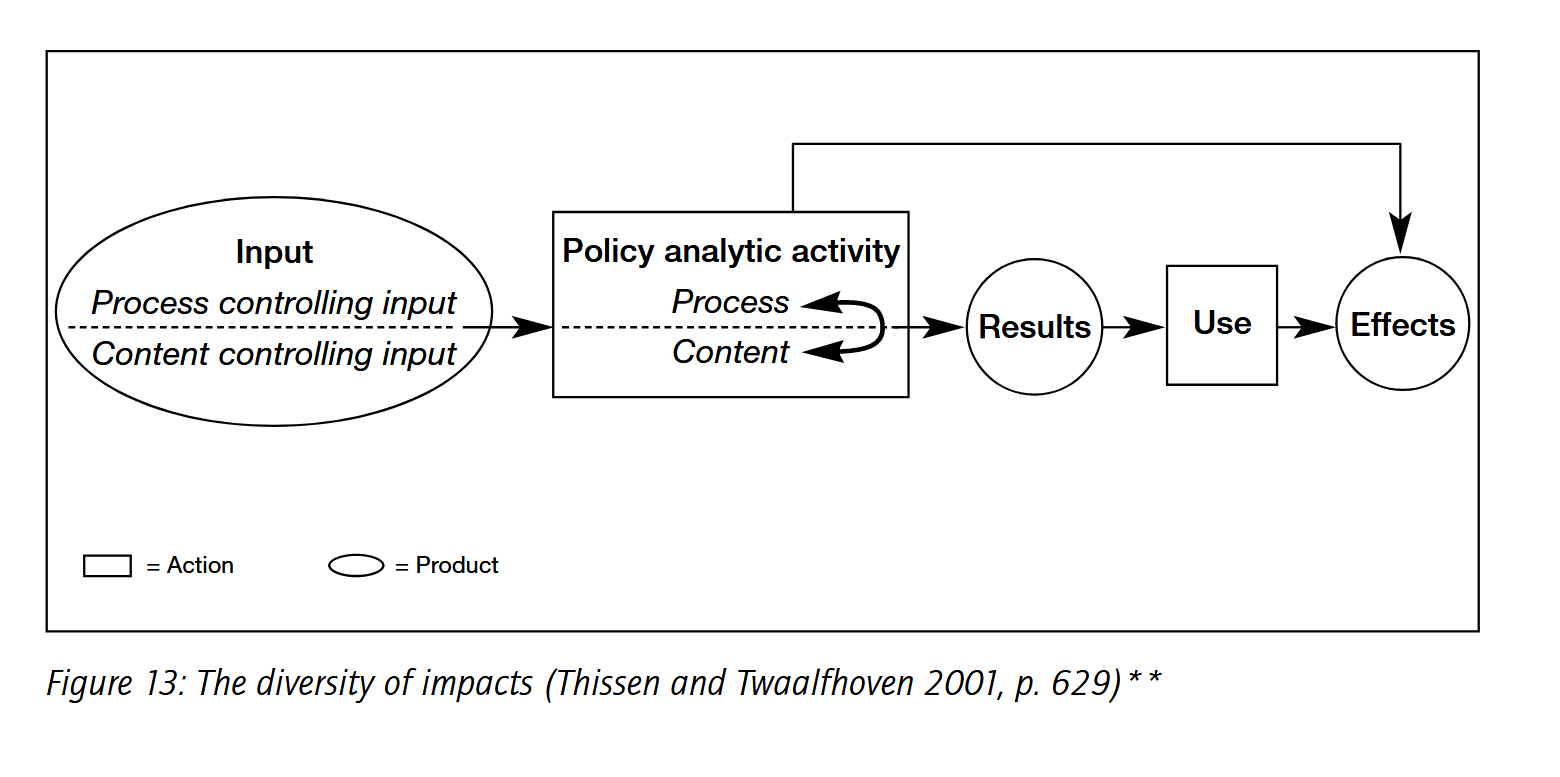
"Differentiation between results and their use underlines the fact that actors in the life-world interpret the same results in different ways and use them for different purposes." (Pohl y Hirsch Hadorn, 2007, p. 63) (pdf)
"Basically, impacts are numerous and occur at various levels; they can be intended or unintended, e.g. TR may influence a decision-making process or may generate new knowledge of problems and possible solutions. But a project can also lead to changes in the perception of the problem itself, or to new responsibilities.85" (Pohl y Hirsch Hadorn, 2007, p. 64) (pdf)
"Conceptual frameworks for assessing the impacts of research on different areas of the life-world can deliver methodologies for adequate description of this multiplicity of impacts.86 Further development of TR in this field will depend on expanding systematic observation and recording the multiplicity of impacts." (Pohl y Hirsch Hadorn, 2007, p. 64) (pdf)
4.4.3 Cognizance of the context of the life-world problems
"To determine how TR should interact with actors in the life-world, it is important to gain detailed knowledge of the state of life-world problem identification and analysis." (Pohl y Hirsch Hadorn, 2007, p. 64) (pdf)
4.4.4 Tailoring results for the target groups
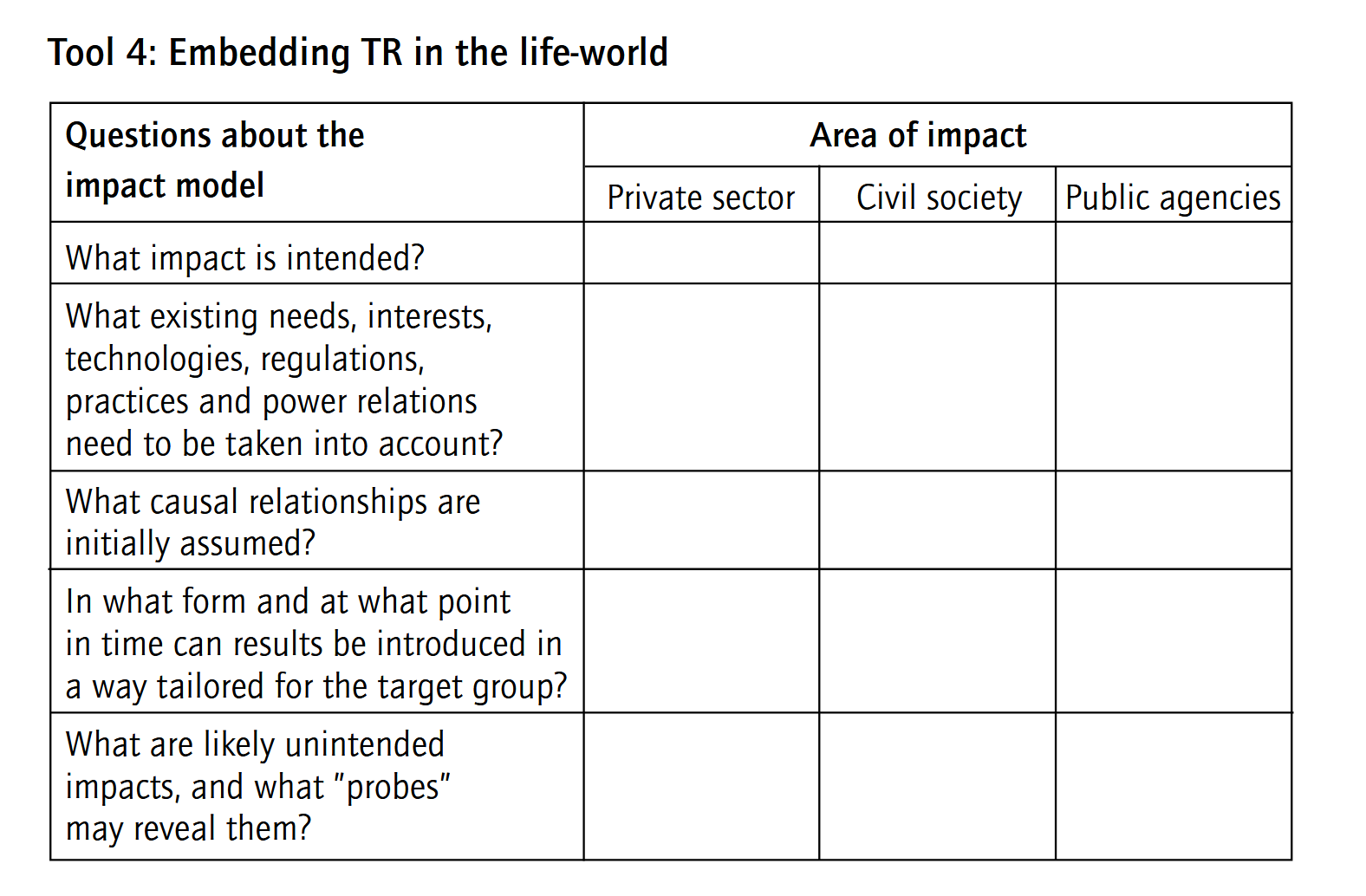
"When the impact model determines specific social groups as targets (e.g. politics, administration, the education system, the private sector, the media or public opinion), tailoring results requires adapting them to the perceptions of target groups as well as to the procedures and schedules to which they are bound." (Pohl y Hirsch Hadorn, 2007, p. 65) (pdf)
challenges:
[image] (pdf)
(pdf)
(Pohl y Hirsch Hadorn, 2007, p. 65)
"Success will depend on a sound search for knowledge about, and conceptions developed by, these target groups and the way in which they deal with the academic world." (Pohl y Hirsch Hadorn, 2007, p. 65) (pdf)
Tool 4: Embedding TR in the life-world
[image]
 (pdf)
(pdf)
(Pohl y Hirsch Hadorn, 2007, p. 65)
4.4.5 Embedding TR in the scientific enviroment
"To this end, when TR projects formulate research questions during the phase of problem identification and structuring, it is important that they refer to the state of the art in research within the relevant disciplines (see Chapters 3.2 and 4.2.2) as well as to the state of the art in the development of problemrelated integration (see Tool 3, p. 67)." (Pohl y Hirsch Hadorn, 2007, p. 66) (pdf)
"To support the impact of TR on developing scientific insights, it is important to determine the corresponding contents, target groups and forms, and to plan their realisation in the various phases of the research process." (Pohl y Hirsch Hadorn, 2007, p. 66) (pdf)
"Results must then be brought into the relevant disciplinary or transdisciplinary debates. This can be done, for example, in the form of contributions to journals and other publications92, through information channelled through networks, or by means of presentation of results at conferences (see Tool 5). These activities can be fruitful already at the stage of problem analysis, as embedding in the scientific context can lead to recursive adaptation of questions and methods" (Pohl y Hirsch Hadorn, 2007, p. 66) (pdf)
Tool 5: Embedding TR in the scientific environment
[image]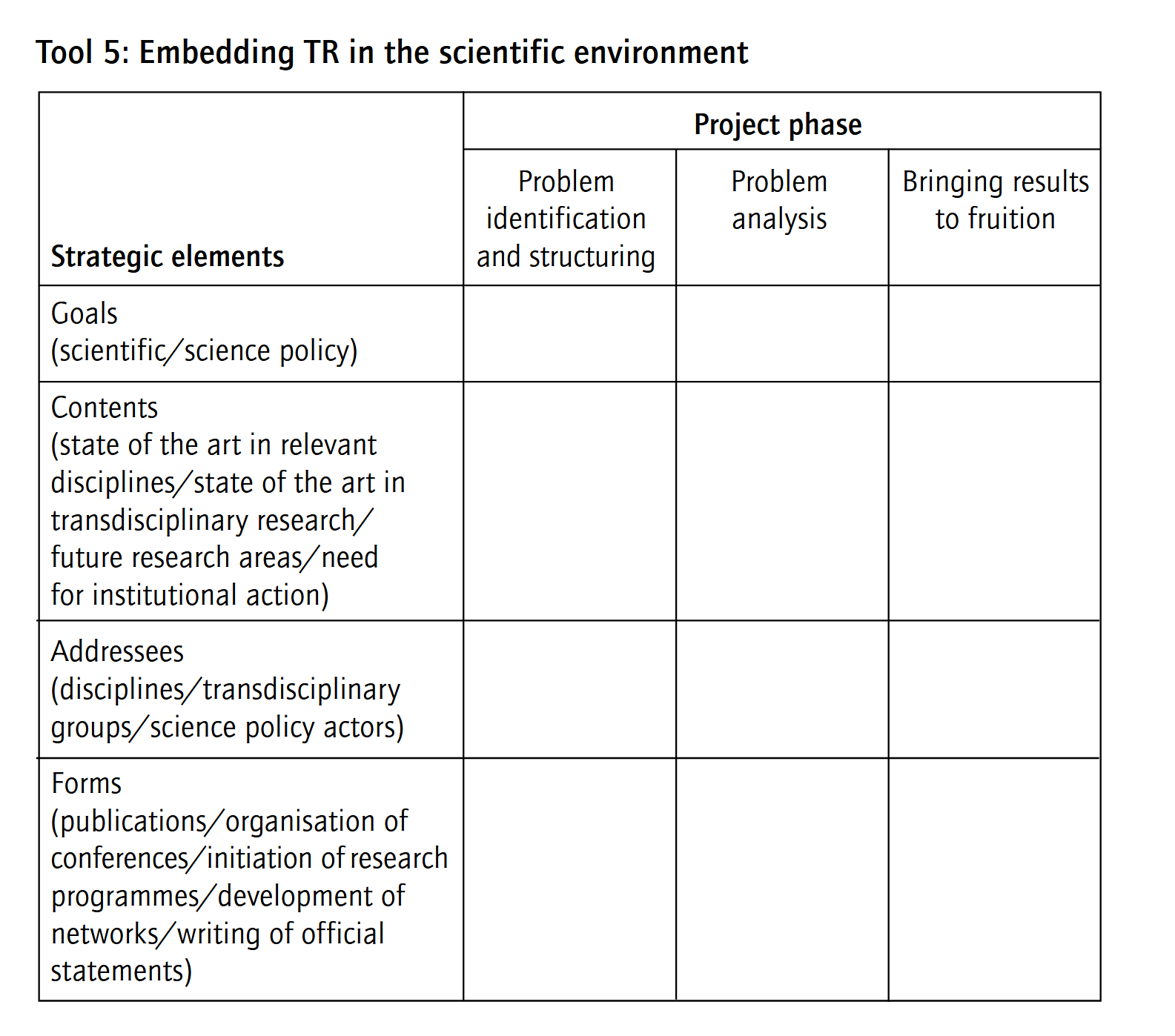 (pdf)
(pdf)
(Pohl y Hirsch Hadorn, 2007, p. 67)