Restricted Complexity, General Complexity
Restricted Complexity, General Complexity
I. “Classical science” rejected complexity based on three principles
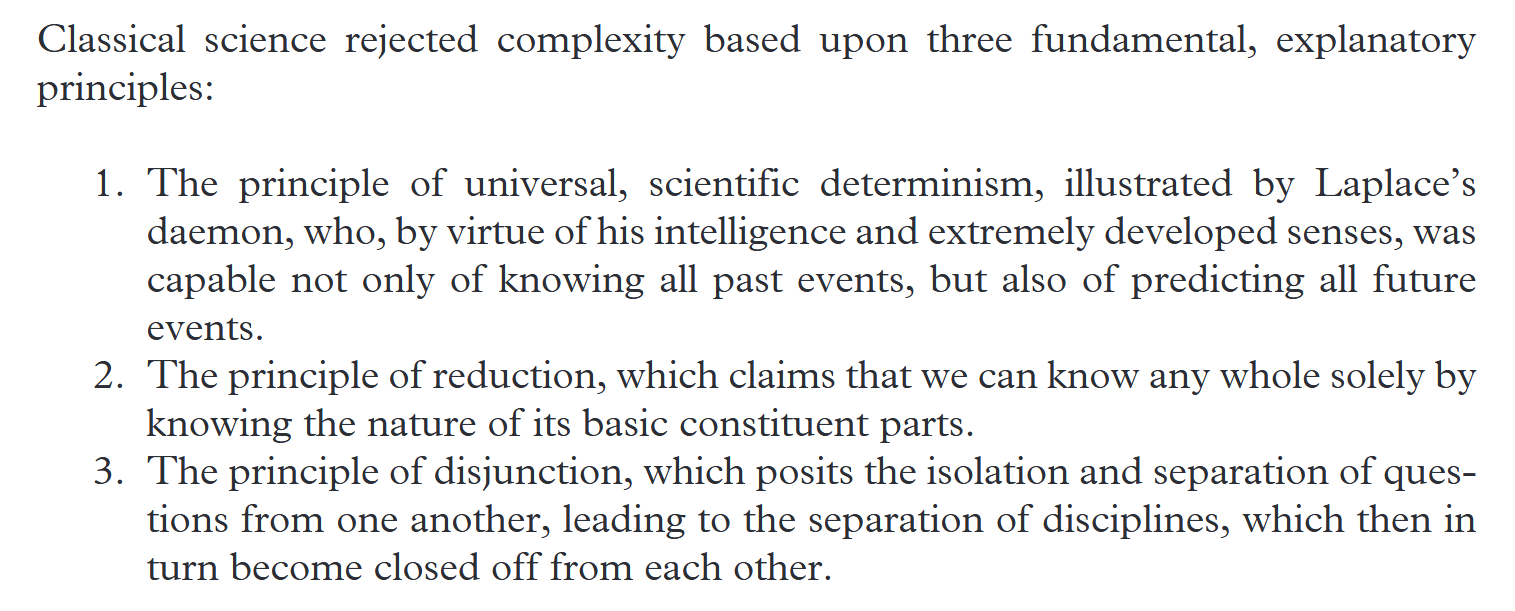 (
("This scientific conception absolutely rejects the notion of “complexity.” On the one hand, complexity usually implies confusion and uncertainty." (Morin, 2021, p. 61) (pdf)
"As a result, complexity is invisible in the way disciplinary fragmentation divided reality. In fact, the first meaning of the word complexity derives from the Latin complexus, which means what is woven together. The primary trait, not of the discipline in itself, but by which the discipline is conceived as distinctive, within its own silo, naturally collapses complexity." (Morin, 2021, p. 62) (pdf)
2. The first breach leading to complexity: Irreversibility
"Complexity appeared with the second law of thermodynamics, which demonstrates that energy degrades into heat over time. This principle of entropy is within linear time. Until then physical laws were in principle reversible. Even in the conception of life, species were fixed and did not require tim" (Morin, 2021, p. 62) (pdf)
"The important point here is not only the emergence of linear time and irreversibility, but also the appearance of disorder, since heat is conceived as the agitation of molecules." (Morin, 2021, p. 62) (pdf)
"The acceptance of disorder, dispersion and disintegration dealt a fatal blow to the perfect, ordered, and determinist vision of the universe put forth by traditional science." (Morin, 2021, p. 62) (pdf)
3. Interactions: Order/disorder/organization
"How is it that the phenomena of order and disorder are related? This is what I tried to explain in the first volume of La Méthode (Method). We need to associate the antagonistic principles of order and disorder and to associate them in such a way that another principle emerges: organization." (Morin, 2021, p. 63) (pdf)
4. Chaos
"All this affected the dogmas of classical science." (Morin, 2021, p. 63) (pdf)
"A chaotic process may obey deterministic initial states, but these states cannot be known completely, and the interactions generated within this process can alter any" (Morin, 2021, p. 63) (pdf)
"prediction. Negligible variations have considerable consequences over vast periods of time. In this physics, the word chaos has a strictly limited meaning related to apparent disorder and unpredictability. Determinism is saved in principle, but it is worthless, since one cannot know the initial states completely. In fact, we are, since the original explosion and forevermore, plunged in a chaotic universe." (Morin, 2021, p. 64) (pdf)
5. The emergence of complexity
"In the forties and fifties, the idea of complexity was at the heart of a sort of spiral nebula of mathematicians and engineers connected with what we know call Information Theory, Cybernetics, and General System Theory which emerged more or less at the same time." (Morin, 2021, p. 64) (pdf)
"An opening came at the Santa Fe Institute (1984) where the term “complex systems” was essential to defining dynamical systems with a vast quantity of interactions and feedback within which occur processes that are very difficult to predict and control and where classical scientific concepts become useless." (Morin, 2021, p. 64) (pdf)
"The dogmas or paradigms of classical science began to be disputed." (Morin, 2021, p. 64) (pdf)
"We now arrive at the type of complexity I call “restricted.” The word complexity is introduced in “complex systems theory.” In addition, here and there the idea of “sciences of complexity” was introduced, encompassing the ideas of fractals and chaos theory" (Morin, 2021, p. 64) (pdf)
"The epistemological division between restricted and generalized complexity appears because I think that any system, whatever it might be, is (or can be understood as) complex by its very nature" (Morin, 2021, p. 65) (pdf)
"Restricted complexity has made potentially important advances in formalization, and in the possibilities of modeling, which themselves favor interdisciplinary potentialities. But we remain within the epistemology of classical science. When we search for the “laws of complexity,” we still attach complexity as a kind of boxcar behind the real locomotive, the one that produces the laws. A hybrid was formed between the principles of traditional science and the advances towards which it was moving. In fact, in the process, we avoid the fundamental problems of complexity, which are epistemological, cognitive, and paradigmatic. To an extent, we recognize complexity, but only by decomplexifying it. In this way, the breach is opened, but we try to plaster it over: the paradigm of classical science remains, only fissured" (Morin, 2021, p. 65) (pdf)
6. Generalized complexity
"But what, then, is “generalized” complexity?" (Morin, 2021, p. 65) (pdf)
"In opposition to reduction, complexity requires that we to try to comprehend the relations between the whole and the parts. Knowledge of the parts is not enough, and knowledge of the whole as a whole is not enough, if one ignores its parts. Rather, one is compelled to loop back and forth to garner the knowledge of both the whole and its parts. The principle of reduction is substituted by a principle that conceptualizes the whole/parts relationship." (Morin, 2021, p. 65) (pdf)
"The principle of disjunction, of separation (between objects, between disciplines, between theories, between the subject and the object of knowledge), should be substituted with another principle that maintains distinction, but seeks to establish relationship." (Morin, 2021, p. 65) (pdf)
"The principle of generalized determinism should be replaced by a principle that conceives of the relationship between order, disorder, and organization." (Morin, 2021, p. 65) (pdf)
"Now, let us examine three notions that are present, but, in my opinion, not articulated explicitly, in restricted complexity: system, emergence, and organization." (Morin, 2021, p. 65) (pdf)
7. System: “All systems should be viewed as complex”
"What is a system? It is a relationship between parts, which can be very different from each other and which constitute a whole that is simultaneously organized, organizing, and organizer." (Morin, 2021, p. 66) (pdf)
"The whole is not only more than the sum of its parts, but it is also less than the sum of its parts" (Morin, 2021, p. 66) (pdf)
"Why? Because a certain number of qualities and properties present in the parts can be inhibited by the organization of the whole." (Morin, 2021, p. 66) (pdf)
"Consequently, as Pascal said, we should conceive a circular relationship: one cannot know the parts without knowing the whole, but one cannot know the whole without knowing the parts." (Morin, 2021, p. 66) (pdf)
"The principle of organization, therefore, becomes critical, since it is through organization of the parts in a whole that emergent qualities appear and inhibited qualities disappear.5" (Morin, 2021, p. 66) (pdf)
8. The emergence of emergence
"What is critical to understanding emergence is that it cannot be deduced from the qualities of the parts and is therefore irreducible. It appears only in the organization of the whole." (Morin, 2021, p. 66) (pdf)
9. The complexity of organization
"Emergence is fundamental, but it redirects us to the problem of organization, and it is organization that gives consistency to our universe." (Morin, 2021, p. 67) (pdf)
"If we already think that there are problems of irreducibility, of non-deductibility, and of complex relations between parts and whole and if we think, moreover, that a system is a unit composed of different parts, and then we must bond unity and plurality or, at least, diversity. We realize that we must arrive at a logical complexity, because we must link concepts which are normally diametrically opposed, like unity and diversity." (Morin, 2021, p. 67) (pdf)
"We are obliged to link order, disorder and organization, which we traditionally consider opposed in accordance with the understanding that unfortunately has been instilled in us since childhood. Then, we comprehend what I have called self-ecoorganization, i.e. living organization." (Morin, 2021, p. 67) (pdf)
15. The need for contextualization
"Let us take again the term complexus, meaning “what is woven together.” It is a very important word, which indicates that the fracturing of knowledge prevents us from linking and contextualizing." (Morin, 2021, p. 71) (pdf)
"It is therefore necessary to recognize the inseparability of the separable and the historical and social levels ias have been recognized alrady at the microphysical level" (Morin, 2021, p. 72) (pdf)
"We can conclude therefore that everything that is separated is at the same time inseparable" (Morin, 2021, p. 72) (pdf)
Notas relacionadas
De momento no hay notas relacionadas ( ˘︹˘ )
Últimas notas cultivadas
| Archivos | Fecha | Estatus |
|---|---|---|
| 1.1 La complejidad de la divulgación | 7:24 PM - March 13, 2026 | Semilla |
| 1.2 Democratización, lenguaje y enseñanza | 7:30 PM - February 20, 2026 | - |
| 1.3 Relaciones disciplinares de la divulgación | 7:36 PM - February 20, 2026 | - |
| Introducción¿ | 8:29 PM - February 20, 2026 | - |
| 1. Introducción | 2:00 PM - February 06, 2026 | Plantícula |
Siguiente 
 Anterior